
How Tall Tales Got Designed (in Letters)
May 14, 2026 · by Michael Morrison
The two letters I mailed to my brother in early 2002 are the closest thing to a design diary Tall Tales has — capturing the moment the game's mechanics actually clicked.
In January 2002 I dropped an envelope in the mail addressed to my brother Steve. Even in 2002, mailing a letter to a sibling was unusual — but these weren’t usual circumstances, and the address wasn’t his usual one. He was, in the letter’s own phrasing, in a “new temporary environment” — incarcerated, briefly, in one of the not-good stretches that bracketed the good ones.
The first article in this series covered the good stretch right before this one: the Starbucks evenings of fall 2001, with my brother sober and focused on recovery. This letter was written into the chapter after. It calls his situation “on holiday,” in scare quotes, throughout — the laugh-to-keep-from-crying register my family relied on when things got hard.
The envelope I mailed Steve was thick, six or seven typed pages. It probably looked like any other mail-from-home letter, but it was not a mail-from-home letter at all. It was a design document.
The first paragraph said this:
Steve,
I hope you’re doing OK and adjusting to your new temporary environment. Believe it or not, I have several things I want you to help me accomplish while you’re “on holiday.” For right now, I’d like to focus on figuring out the details of my Tall Tales game.
It was my attempt to keep a relationship going by focusing on a task that could be carried out in letters, and that’s the moment Tall Tales started being designed by mail. Incarceration aside, my brother was the person in the world I most trusted when it came to comedy and engineering fun. I had a brain to bounce ideas off, several weeks of his undivided attention, and — for that brief window — a postal address he could reliably be reached at. So I sent him the design and asked for his help.
The State of the Game in January 2002
The first article in this series described how the Starbucks evenings of the previous fall had quietly redesigned Tall Tales into a lounge game — a card game small enough to fit on a coffee shop’s outdoor table. What that article skipped over is what the actual design was at that moment. The lounge form factor had landed. The mechanics had not.
In the January letter, the game had three question types:
- Fact-or-Fiction — True/False questions about urban myths and weird facts.
- Tall Tales — multiple-choice “news of the weird” questions, where I had to invent two plausible-but-wrong answers Balderdash-style.
- Urban Legends — pure Balderdash, where players wrote made-up endings to bizarre stories and voted on the best one.
I mention Balderdash because it was a family favorite, and my brother tended to dominate at the creative bluffing part of the game. One of his notable wins was tricking us into believing one of the random names in the game was “the inventor of the V-neck collar.” It seemed too ridiculously specific to be a bluff…I had the right person to help with Tall Tales.
To give Steve a feel for the Fact-or-Fiction tone, I reproduced eight sample questions in the letter:
- The Great Wall of China can be seen with the naked eye from the moon.
- Hamburgers and frankfurters are named after cities in Germany.
- A man by the name of Thomas Crapper invented the flush toilet.
- More cases of spousal abuse are recorded on Super Bowl Sunday than any other day of the year.
- Hair and nails continue to grow on corpses after death.
- No two snowflakes are alike.
- Coca-Cola originally contained cocaine.
- The cast of the sitcom Green Acres ate the show’s pig character, Arnold Ziffel, after the show’s final episode.
Answers, in order: F, T, F, F, F, F, T, F. The Great Wall one is the most-repeated lie in the bunch.
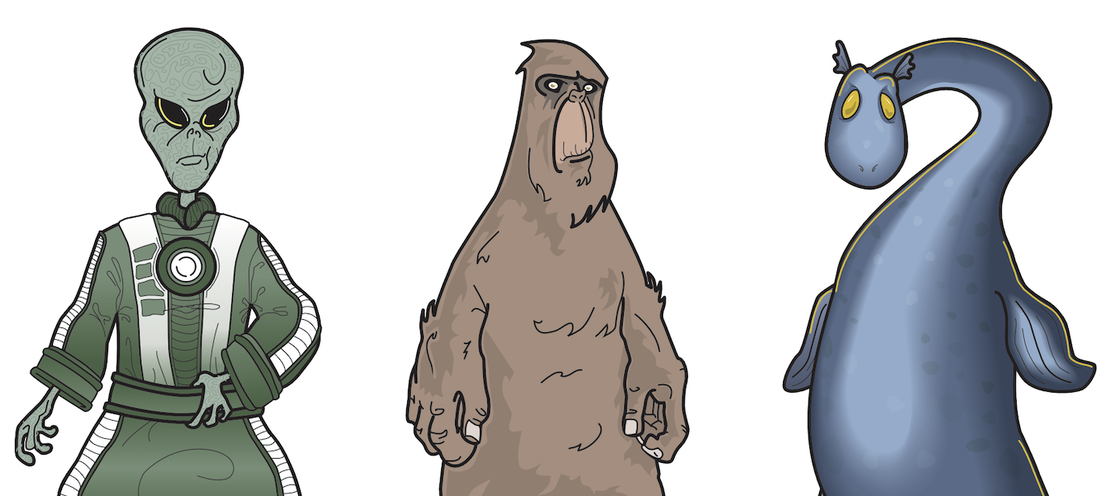
There was also a scoring system I was proud of: instead of points, players would collect Creature Cards that built up a picture of Bigfoot, the Loch Ness Monster, or an alien, one third at a time — head, body, legs. The first complete creature won the game. I’d already worked out a fast-game variant where you could win with a hybrid creature, mixing body parts across the three monsters. The artwork was deliberately going to allow Bigfoot’s head on Nessie’s body on alien feet.
The Topper Problem
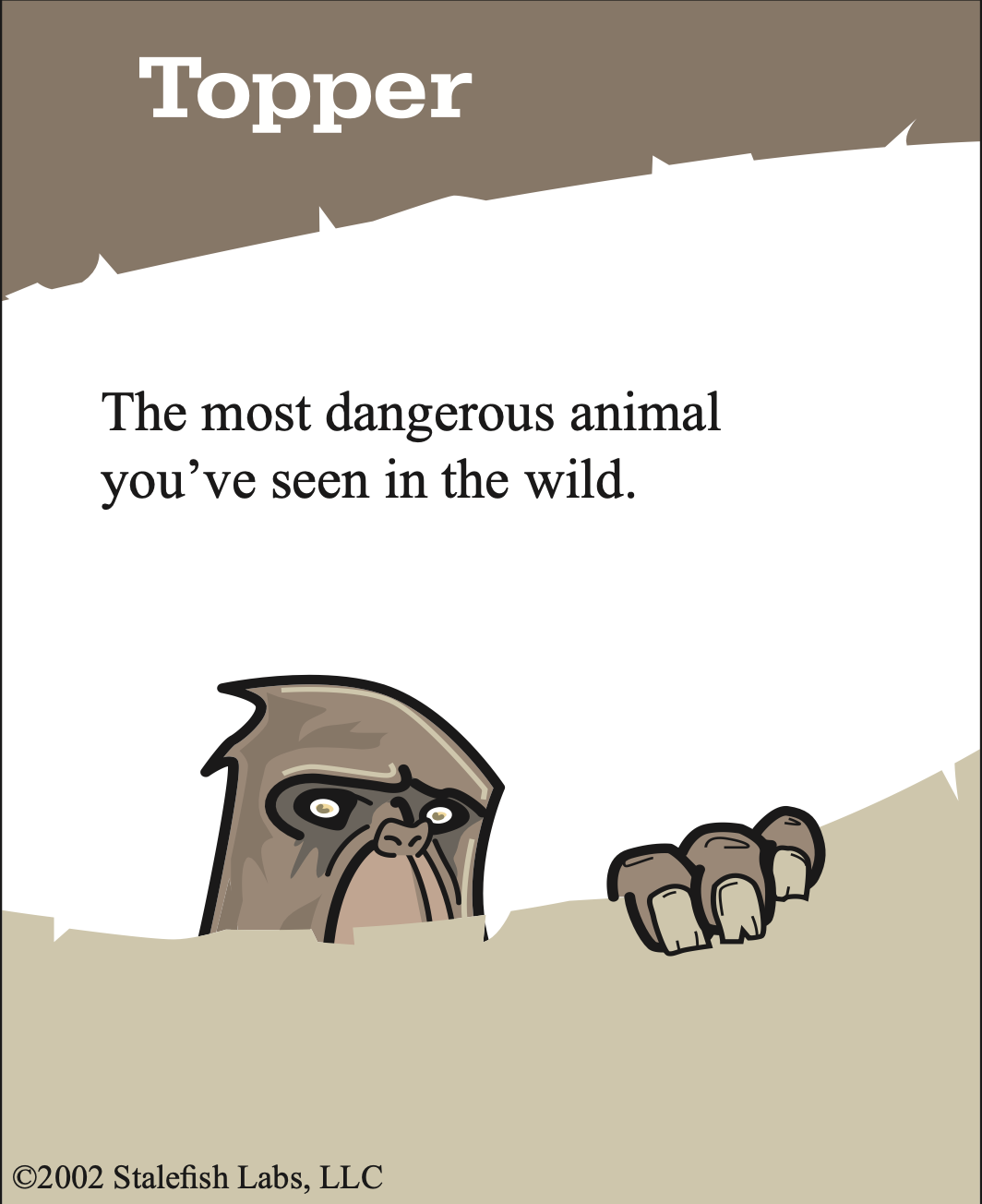
Hidden inside the letter was the actual design question I was wrestling with. I had a different game on the side, called Topper — a one-upmanship game where each player wrote down their answer to a prompt (“the most dangerous animal you’ve met in the wild”), and the goal was to give the wildest answer the other players would still believe. You could tell the truth or you could bluff. Other players could challenge a winning answer; if you’d lied and got caught, you lost a point.
The question I put to Steve was whether Topper should stay as its own game or get folded into Tall Tales as a third question type, replacing the Urban Legends Balderdash mechanic — which, even then, I suspected was too much writing for a lounge game.
I also told him the truth about why I was being so thorough on paper:
It’s not a huge issue, but we’ve learned with the game business that it helps to document everything you do in case someone ever tries to claim they had an idea first. I’ve read lots of stories of the game/toy industry being quite dirty in terms of idea theft, so I’m trying to create a paper trail as I refine this idea.
Of all the lines in that letter that have aged in interesting ways, that one has aged the most. A 2002 indie toy designer earnestly fortifying his correspondence with his incarcerated brother against future intellectual-property litigation. I love that guy. Two decades on, the lesson is: ideas matter, but execution matters way more.
What Steve Sent Back
The reply came on the back of the pages I’d sent — signed at the bottom, as I’d asked. I don’t have it in front of me anymore; it left the file at some point in the next twenty-four years. But the second letter I sent him, six weeks later, opens with the sentence that captures what he’d done:
I really like your ideas for Tall Tales, and I’m definitely going more in your direction with the game. In fact, I like everything you’ve suggested except I’m still a little concerned about doing the Tall Tales one-at-a-time.
That single sentence is the design-decision pivot of Tall Tales. Topper was in. The Urban Legends Balderdash mechanic was out. The third question type would be a one-upping storytelling game where you could bluff or tell the truth, and where other players could challenge you. The bluffing — the texture of bluffing, where you might be lying and might not, and the other players had to weigh whether to risk a challenge — became the defining flavor of the game.
The 3-2-1 Die
The second letter contains one more design move worth pulling out, the kind of thing only a designer working against a manufacturing budget would invent:
We use an oversized traditional 6-sided die that is color coded for each of the different card types. However, instead of having the colors evenly distributed across the 6 sides, there are 3 Myth sides, 2 Urban Legend sides, and only 1 Tall Tale side.
Three sides for the trivia. Two sides for the multiple-choice questions. One side for Topper — the bluffing-storytelling layer that had just been folded in. Roll the die, draw the matching card. The distribution of question types in the game was being controlled by the geometry of the die, not by shuffled deck order or rules-text instruction. It was a manufacturing trick disguised as a mechanic, and it gave the game its rhythm: the lighter, faster trivia came up most of the time, with occasional multiple-choice changes of pace, and a storytelling round only every sixth roll or so — rare enough to feel like an event when it landed.
Knowing the on-table ratio was 3-2-1, I scaled the deck the same way. Three hundred trivia cards, two hundred multiple-choice, one hundred Topper. Six hundred cards total, the deck a six-times scale model of the die.
What Shipped (and What Didn’t)
There’s a complication to the design diary I’ve just laid out. The mechanics in those two letters were the spec for the Full Edition of Tall Tales — die, Creature Cards, 600-card deck, separate rule sheet, full-sized box, the works. The Full Edition never shipped.
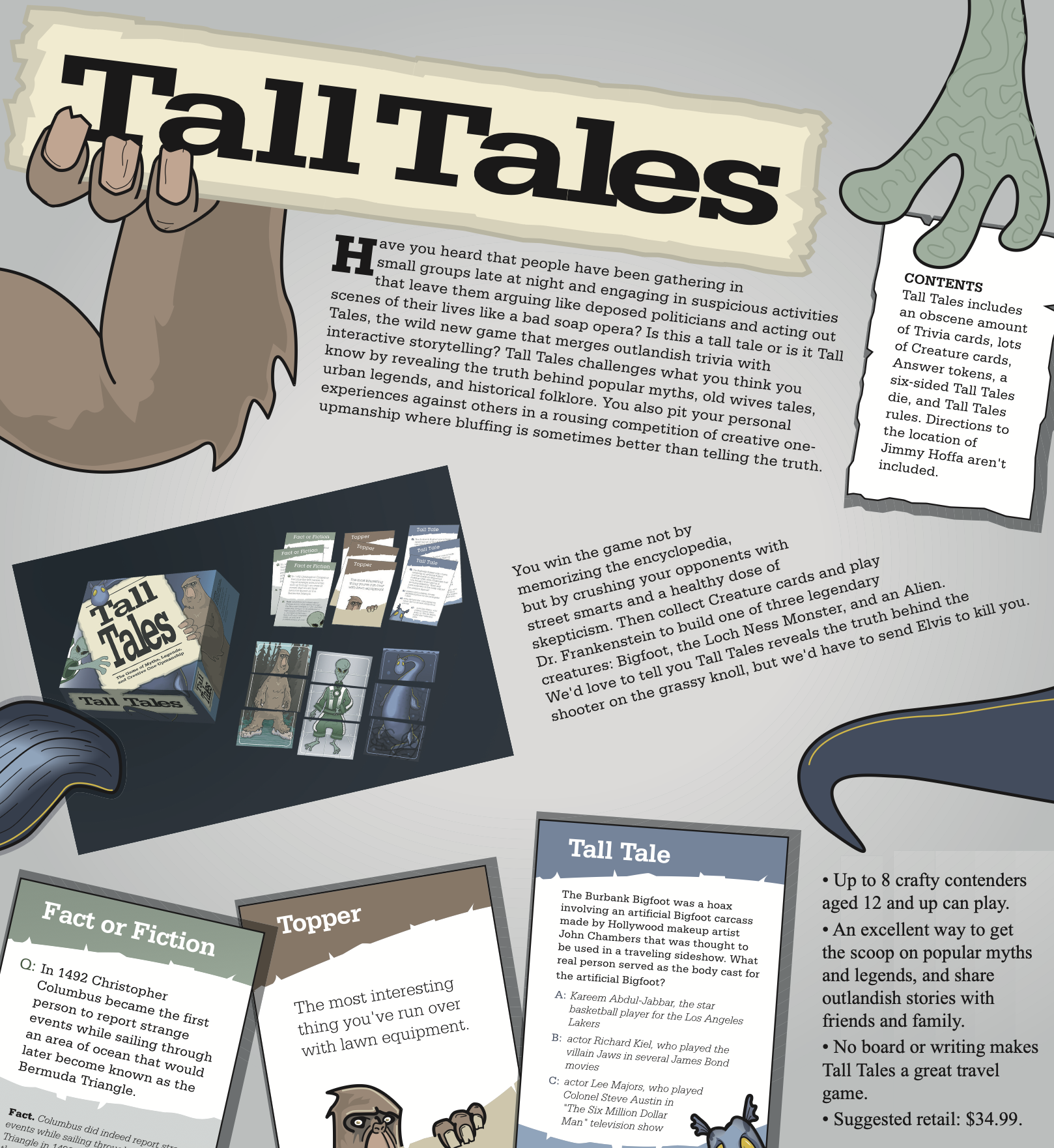
What shipped at the American International Toy Fair in February 2003 was the Pocket Edition, a radical scaling-down of all of it. No die. No Creature Cards. No rule sheet. A single box of cards, with the entire ruleset printed on the back of the box itself. Players drew cards directly from the box; the first to ten points won.
The reason the Pocket Edition became the only edition is the same reason the first article in this series gave for the lounge-game pivot: the Starbucks-table form factor turned out to be the shape the game wanted, not just the box. As I tuned the mechanics to fit that table over the course of 2002, half the apparatus from the Full Edition spec fell away. The 3-2-1 ratio lived more cleanly inside the shuffled deck than it did on the face of a die. The Creature-Card puzzle wanted a longer game than the table wanted. The rule sheet wanted a setup ritual the table didn’t have time for.
What survived was the part Steve had touched. The three question types and their proportions. The Topper bluffing layer, lifted whole from his letter as the third category. The decision to drop the Urban Legends Balderdash mechanic and use the slot for storytelling instead — his call, in his reply on the back of the pages. The category names wandered along the way (in his letter they were Myth questions; on the shipped Pocket Edition box they were Humdingers), but the categories themselves held, and so did their ratio.
The lounge-game thesis came from the constrained space of the Starbucks tables. The category structure that filled the lounge form came from a one-month correspondence with a brother on “holiday.” The mechanical apparatus around that structure — die, creature puzzle, rule sheet — got stripped out before print, and the two letters are now the only place that apparatus survives. The decision in the design, the one my brother catalyzed, made it all the way to the printed box.
I never told this story when the game went out to retailers, because it would have read as a sob story attached to a product spec, and the product spec was supposed to stand on its own.
It does stand on its own. Steve died a few years ago — the first article in this series tells that part of the story, and I won’t retell it here. But I want the design diary to exist, somewhere, in a form he would recognize as accurate. He helped design this game. He signed the back of the pages.
Want more like this?
Subscribe to get new posts from the lab delivered to your inbox.
or grab the RSS feed