


My Name Is Inigo Montoya
There may be no better bedtime story in cinema than The Princess Bride. Not the story-within-the-story, but the frame. Peter Falk on the edge of a bed, plainly enjoying himself. That is the energy Sojourn — our new bedtime-story app, where one person reads aloud to another — spent months learning to get right.
There may be no better bedtime story in cinema history than The Princess Bride, and it’s worth understanding exactly why. Not the story-within-the-story, though that’s great. The frame: Peter Falk, sitting on the edge of a bed, reading to his sick and skeptical grandson. Watch Falk’s performance the next time it’s on. He’s not performing literature. He’s not being careful or reverent. He’s enjoying himself. He knows the good parts are coming. He lingers where he wants to linger. He skips ahead when the kid needs him to. He has told this story before, and he likes it more every time.
That energy — the yarn-spinner’s visible pleasure in the telling — is the thing most bedtime stories for adults get wrong, and the thing I spent months learning to get right in Sojourn.
A quick frame for the rest of this essay, Sojourn is the bedtime-story app for grownups that I’m building at Stalefish Labs: one person reads aloud to another, the story unfolds across several nights, and the reader quietly steers the path through choices the listener never sees. The listener just hears a story. Although there are choices made along the story path, the reader’s job is simply to tell a bedtime story to someone they love. Every word they read was drafted, argued with, and cut down long before anyone opened the app. The voice all that cutting was trying to arrive at is what the rest of this essay is about.
“Bedtime stories for adults” is a phrase that wants unpacking, so a word on why Sojourn exists at all. Children get read to. Patients sometimes do. Adults, almost without exception, just stop. Sleep apps stepped into that gap with a famous stranger reading something soothing to you alone, and the gap stayed open. Audio was never the missing part. The missing part was being given the story: someone choosing it for you, in the same room, with the lights off. Sojourn exists because that ritual deserves to come back for grown-ups, and because reading aloud to someone you love turns out to be one of the better small acts of care two people can build into a week.
The Stories I Built First
I don’t consider myself a natural storyteller, especially not in a sense that I can just conjure up a coherent series of beats out of thin air. But I have ideas, lots of them, and I kinda know what works and what doesn’t. So I employed AI to help fill in for my storytelling deficiencies. Sojourn’s early stories were beautiful. They were also melancholy, and I didn’t initially notice the second thing because I was so pleased with the first. This is the AI trap, more or less: the prose comes out polished enough that you mistake polish for fit, and forget to ask whether it actually works in the room you’re going to read it in.
The storytelling voice I’d built was a literary one: perceptive, careful, attentive to small enchantments in the world it described. The prose was polished to a shine. Every session opened with a smell — woodsmoke, wet stone, bread cooling on a sill — rendered in a sentence that had clearly been worked on. The wonder always meant something; if there was a lighthouse, the lighthouse was about something. It read well. At least to the extent that I was gunning for a bedtime story with Tolstoy’s patience in laying out the philosophy of warfare in War and Peace. I was not, and read testing proved it.
I read an early story to my wife. (Sojourn is mostly just me building it; she’s the read-aloud QA team here, and more or less the entire point of the product.) This is the thing you are eventually forced to do with a product whose entire job is to be read aloud in the dark. I didn’t expect how exhausting it would be. Not bad, just exhausting, which is its own kind of problem for a bedtime story app. Every simile asked me to stop and build a small comparison in my head before I could continue. Every opening paragraph made me inventory a room with my nose. The narrator was kind and observant and never, at any point, seemed to be having any fun or have even the slightest concern for moving the story forward. It took itself seriously in a way that made the listener feel heavy rather than held. It was a story for someone who wanted to admire a story, not be wrapped up in one. Nobody reaching for a bedtime story wants to admire it. They want to be carried somewhere by someone who knows the way and is glad of the company. That’s the job Sojourn wants to set the reader up to do. The early stories were huge fails in that regard.
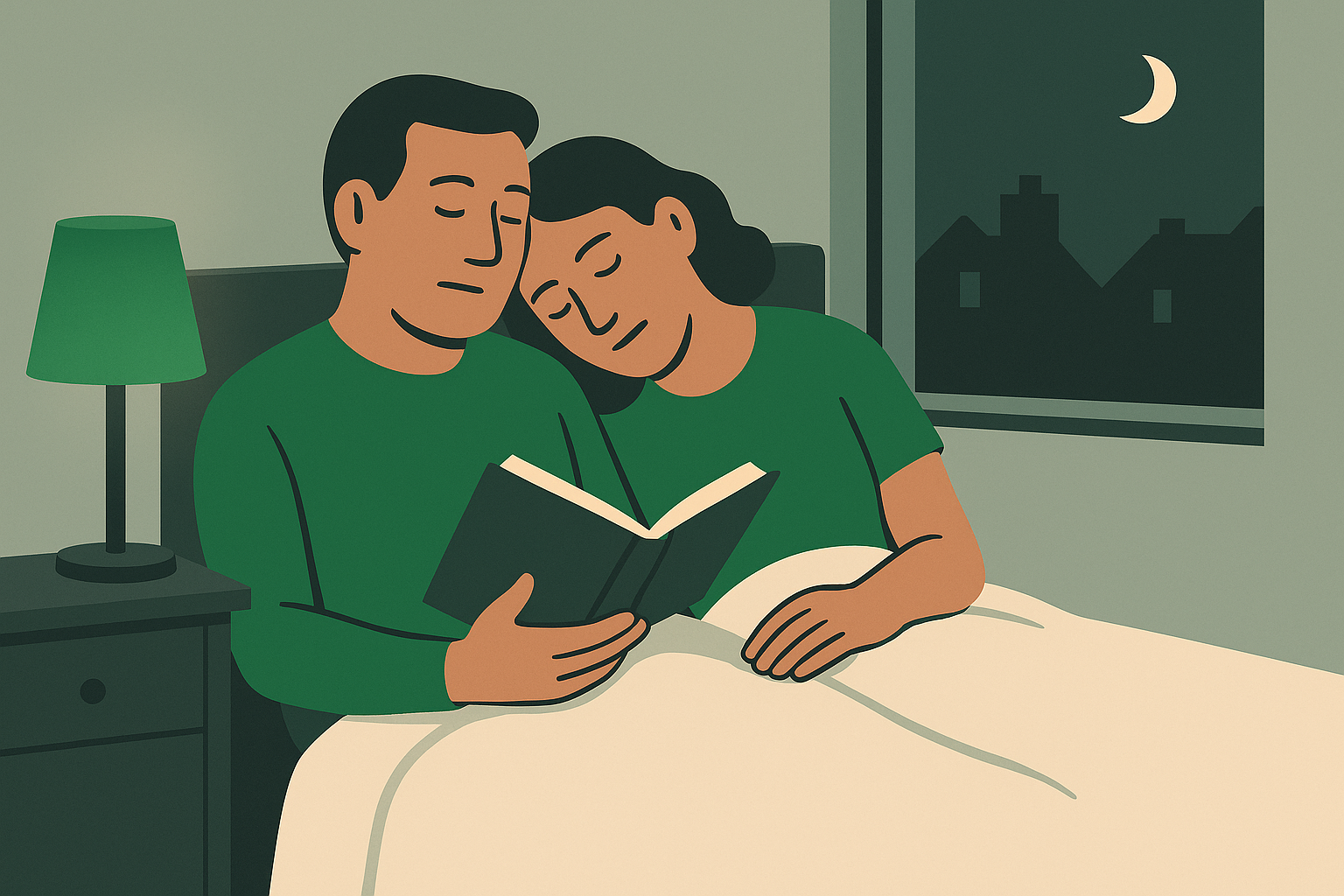
It turns out I’d built stories for a literary narrator, which are fantastic for reading novels alone. But reading aloud to another person requires something different. What I needed was stories for a yarn-spinner. It took an embarrassingly long time to say that sentence out loud, and a single movie to understand it.
What Inigo Montoya Actually Is
Pull the most beloved thread out of The Princess Bride and look at it without the warmth around it. A boy watches a six-fingered man murder his father over a sword. He spends the next twenty years training his body into a single instrument of revenge, drinking between contracts, his whole life narrowed to one sentence he intends to say before he kills someone. That is grief and vengeance and two decades of arrested mourning. As heavy as a story gets.
Yet nobody watches it that way. Nobody comes out of that movie heavy. The film holds that weight with so much warmth and specificity and delight that the gravity becomes fuel for the story instead of a load on the audience. Inigo is funny. He’s courtly. He’s specific in the exact way that makes you love a person rather than note a character. “I do not mean to pry, but you don’t by any chance happen to have six fingers on your right hand?” That is a line about a twenty-year blood vendetta, delivered as polite small talk to a stranger. It works not in spite of how heavy the underlying thing is, but because the storyteller plainly trusts you to hold the heavy thing and the light thing in the same hand and not drop either one.
Big Fish is the same trick run at feature length. If you haven’t seen it, add it to your list. It is, underneath, a son sitting at his dying father’s bedside, furious that he never got a straight answer about who the man actually was. It is told almost entirely through tall tales: a giant, a witch with a glass eye, a town too perfect to leave, a fish nobody can catch. The stories are absurd. The grief is real. Neither one cancels the other; they’re true at the same time, and the absurdity is precisely what makes the grief survivable, for the son and for us. And the son never gets an honest answer, yet he leaves with more than one could have given him.
The Principle
Here is the thing those two movies taught me, stated as plainly as I can:
Levity in a time of crisis is perhaps the most adult thing a story can do.
Children’s stories tend to do one of two things with difficulty. They dodge it, or they process it earnestly, sitting the listener down to make sure the lesson lands. Both are fine. Neither is what an adult listener, lying in the dark at the end of a hard day, actually needs. What they need is the third thing, the thing only a grown-up story can pull off: difficulty and delight held simultaneously, by a teller calm enough to find the world delightful even where it is hard.

Worth pausing on the exceptions, because the best children’s books absolutely do hold difficulty and delight in the same hand. Charlotte’s Web makes you laugh at Templeton on one page and grieve a spider on the next, and never asks you to choose. The Velveteen Rabbit takes a story about a sick child and a toy about to be burned and somehow makes it the most consoling book on the shelf. The trick is the Skin Horse, an old toy who explains being loved as the thing that wears you down to something real. These books work for the same reason The Princess Bride works: the writer trusts the listener, even a small one, to hold the weight while the story moves around it. They are, in that sense, secretly adult books. The thing they did first, that grown-up sleep content keeps re-learning, is treat the listener as someone worth telling a real story to.
And the counterintuitive payoff is this: that’s what makes the listener feel lighter at the end, not heavier. Not because the story tiptoed around the hard thing. Because the person telling it was warm and funny and trustworthy enough to walk them straight through it and out the other side. If there’s one thing I wanted to accomplish with this project, it’s that establishment of trust, where you read the synopsis of a story that on paper absolutely should not work at bedtime, but Sojourn has proven to you that it can do it by building that trust.
Speaking of trust, there’s a trap every “calm” product falls into, Sojourn included, for a while. You confuse safe with inert. You think the way to soothe someone is to make sure nothing happens. But emptiness isn’t safety. A story where nothing happens isn’t restful; it’s just thin. The rest has to be earned. There has to be a want, some resistance, a turn, a small surprise; only then does the quiet at the end mean something. Charlotte’s Web has real stakes. The Princess Bride is about grief and revenge. Both leave you better than they found you. Both build trust by taking risks, making you maybe just a little uneasy about where this could go, and then rescuing that unease with heart.
What Changed in Sojourn
In the pivot away from safe and inert, the Sojourn settings never changed. Sojourn’s stories can still be about loss, inheritance, an old debt, a reckoning with someone gone. I didn’t sand the difficulty out. I changed the hand holding it.
The brief for that voice went from warm, perceptive, literary to a warm storyteller who clearly enjoys spinning the yarn. The reference shelf changed with it. Out went the implied literary-fiction influences, and in came Peter Falk and Albert Finney and Mark Twain and Pratchett and Miyazaki, tellers whose pleasure in the telling is the whole point. The wonder engines were released from their obligation to mean something. A lighthouse is allowed to just be a wonderful lighthouse now; some wonder is only wonder, and that turns out to be enough. The prose loosened up: fewer similes, far less sensory inventory at the top of every session, more forward motion, more delight. And the humor widened, from dry, careful wit into gentle absurdity, characters with completely unearned confidence, objects that carry more dignity than they have any right to. The kind of thing that makes an adult smile in the dark, not necessarily laugh out loud.
None of this made the stories lighter in subject. It made them lighter to carry. That was always the goal; I’d just been measuring it with the wrong instrument.
The Test
There’s only one test, and it’s the one I should have run first.
Read it aloud.
Does the reader sound like they’re performing something weighty and important? Or do they sound like Peter Falk, someone who loves this story and genuinely cannot wait for you to hear what happens next? If it’s the first, the prose is wrong, no matter how good it is on the page. Cut it until it’s the second.
That test turned out to have a harsher second form I didn’t plan for. Sojourn also ships a narrator mode, and baking that audio meant hearing every story read aloud by something with no goodwill toward me at all. I’m a forgiving reader of my own work. I know where the sentence is going, so I land it correctly without noticing I’ve done anything, and the warmth I hear is warmth I put there myself. The bake puts nothing there. It reads what is actually on the page, at the pace the punctuation asks for, and any line that was only working because a sympathetic human kept rescuing it comes out flat and stays flat. The mispronunciations are their own entertainment: the lead ant read as a metal, a bass the size of a Buick as a gigantic guitar. But the errors were never the useful part. The absence of charity was. A line that still spins the yarn when read by something that doesn’t care will spin it for someone who does.
The listener does not need to be impressed by the writing. They will not remember the writing, and it’s not the point. What they need — the entire job, the whole product — is to feel that someone is taking care of them through the simple, unhurried pleasure of telling them a good story. Someone on the edge of the bed who is plainly enjoying the telling, lingering where they want to linger, and skipping ahead the moment they sense you need them to.
This is also why the model never gets to be the storyteller. The default for AI products that try to feel intimate — Replika, character.ai, the conversational assistants — is a model addressing you directly, composing its half of the exchange while you sit there waiting for it. Sojourn goes the other way. What reaches the dark room is a finished story, drafted and argued with and cut down months ago in a room you were never in, every line through my hands before it got anywhere near yours. Nothing at bedtime is deciding anything about you.
None of that was settled from the start. For months the app generated each night live, which is maybe how you’d expect an AI story app to work, and I fought hard to make that version good. I wanted every single read of every story to be unique. It got close. What it never got past is that live generation hands a tired, wide-open person the model’s worst sentence of the evening on whatever night the model happens to write one, and bedtime is the wrong place to roll that die. The full argument is in What AI Polish Does to Hunter S. Thompson; the short version is that some formats live on the model’s variability and some are ruined by it. Bedtime is the second kind. So the stories get finished first and ship whole, which is where this essay started: someone on the edge of a bed with a book that already existed.
The voice on top of that book is meant to be the person lying next to you. Some nights neither of you has a voice left, and the app’s narrator carries the reading instead — the same finished story, read by a stand-in rather than by someone who picked it out for you. It’s a fallback and it’s built like one: a track that swaps out, which is also how a voice recorded a thousand miles from your bedroom eventually gets into the room. None of those voices improvise. That part isn’t negotiable.
That’s the whole thing. Everything else in Sojourn is just engineering in service of getting that voice into a dark room.
The refusal underneath it — the model scaffolds the story and never addresses the listener — is named in the studio’s house principles as AI scaffolds, doesn’t address, and it sits beside the other three in The Walls Don’t Talk.
Want more like this?
Subscribe to get new posts from the lab delivered to your inbox.
or grab the RSS feed