

The Walls Don't Talk: How Stalefish Builds
Four principles that surfaced product by product, never as a manifesto. Together they describe what every Stalefish product is and what every Stalefish product refuses to be.
The line came out of an essay about the app Cairn, at the end of a paragraph about visual restraint, and it was meant to stay there. The walls don’t talk. Cairn is a room; you walk through it and notice what’s there, and the walls carry color and texture and they don’t address you. I wrote it to describe one app. Then I looked at the other things the studio has built and found it describing all of them.
So this piece is the moment of noticing the shape. Four principles run underneath everything Stalefish makes. None of them came from a manifesto. They surfaced one product at a time, one problem at a time, and they turned out to agree with each other before anyone set out to name them. Naming them is the whole job here. Classification without interpretation. Ambient over declarative. Names that don’t narrate. AI scaffolds, doesn’t address. And it’s all effectively part of a philosophy I didn’t fully realize I had adopted until after it had formed: anti-engagement.
Three of the four principles came out of building Cairn, a self-tracking app that hasn’t shipped yet. Cairn’s metaphor is markers along a trail, where the trail is your daily life and the markers are things you want to track: you stack a small stone for each thing you did or that happened to you on a given day, a run or a migraine or an hour of music practice, and over weeks the pile of them shows you the shape of your time. That’s the whole app. It never tells you what the shape means. The fourth principle came from Sojourn, the bedtime-story app I’m building.
Classification without interpretation
Cairn lets you mark a behavior as something you’re cultivating, something you’re watching in yourself, or something that just happens to you. Then it stops. The idea is that simply noticing something can be very powerful, leaving you to form your own opinions on what it means. So the app stores the kind of thing that happened and does nothing else with it: no watch badge, no nudge, no Sunday-night summary announcing that you watched your drinking four times this week. The kind organizes the register. You bring the meaning.
That refusal generalizes. Every Stalefish product hands you a structure for organizing your own experience and then declines to perform the interpretation the structure makes available. The structure is real. What it means is yours.
Most apps that involve habits run this the other way around. They categorize your behavior so the software has something to tell you about it. Cairn categorizes so you have something to think about. On paper the categorization and the judgment are hard to tell apart. On the screen they have nothing in common.
Ambient over declarative
This is the principle that named the piece. I was trying to model continuous state — travel, injury, a window of time that colors the discrete happenings inside it. Not things you log once, but conditions you live through, which explain why a stretch of data looks the way it does. I needed to know that my bike rides and skate sessions were lagging during a certain period because I was rehabbing a knee injury. I’d spent years failing to encode that as tags, because a physical therapy tag is a discrete event and a knee injury is a shape the events sit inside, or in some cases an explanation for events that are notably missing. For example, I haven’t graduated in skill or seriousness to carrying a bass guitar on a trip, so travel is a good indicator as to why I didn’t practice during a certain period.
Cairn got a new primitive, and it arrived wearing three layers of deliberately quiet treatment: a thin colored band, a soft background tint, a small capsule chip. Each was tuned so you could ignore the overlay completely and the app still made sense. Ambient visuals set information in front of the eye and let it decide whether to look. Declarative visuals — the badge, the banner, the count, the “you have three new” card — are built to be looked at, which means something is doing the showing. The Citizen’s Daily Brief had already made a version of this call by refusing every modern app pattern on purpose; Cairn arrived at the same place from a different direction.
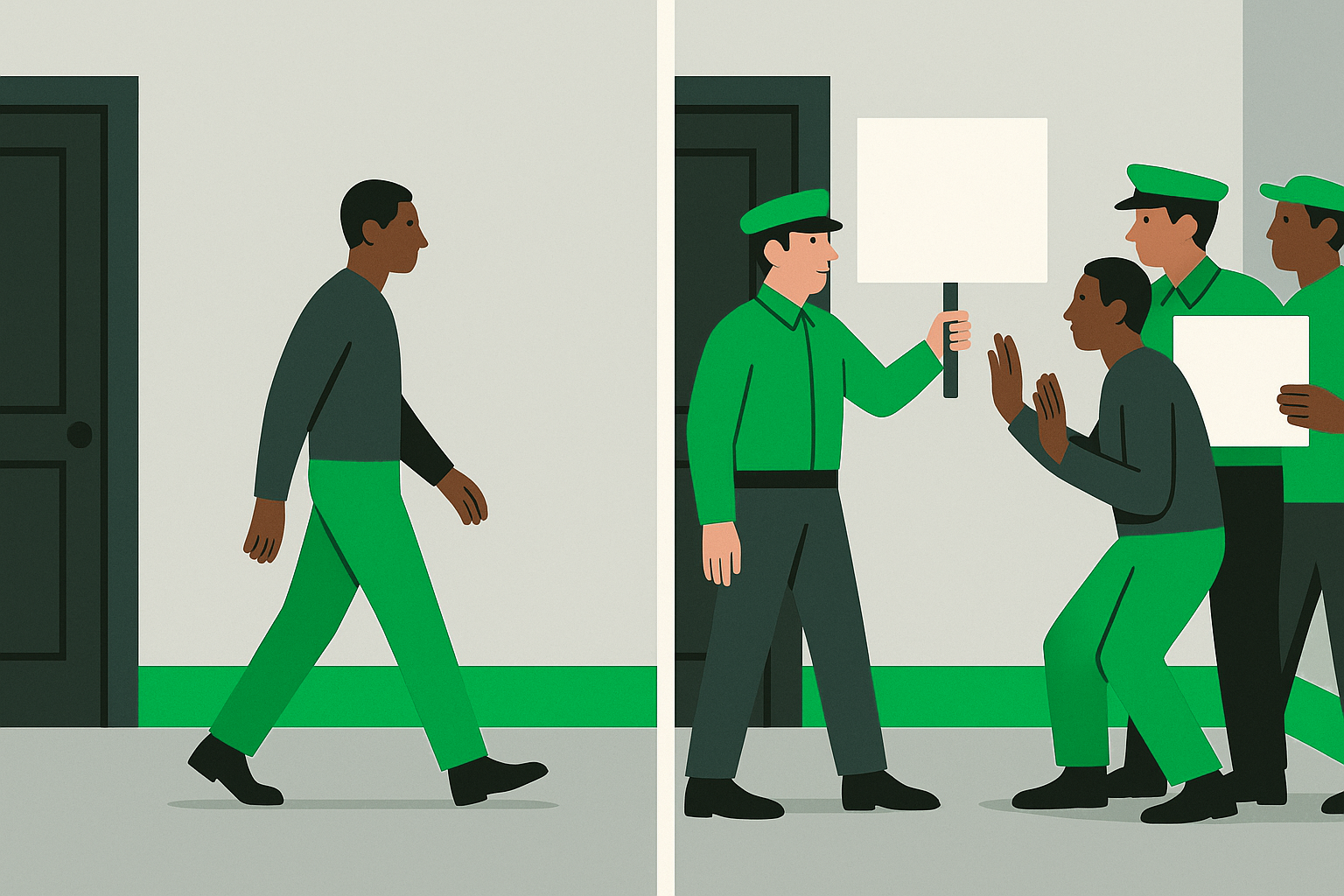
Someone talking at you. That is the thing these products try not to have. The app is the room, you are the person walking through it, and the walls can be painted and lit and patterned without any of it turning to face you. They don’t talk. They just are.
Names that don’t narrate
The first word I reached for, adding a multi-day primitive to Cairn, was “chapter.” It felt warm and literary and completely wrong: a chapter implies a narrator and a reading order, and Cairn grants itself neither. The word I kept was already sitting inside the trail metaphor. Terrain. Observational, geological, indifferent; it carries what the data model actually does and never once suggests the app is writing the story of you.

Names are the edges of a concept. A literary word inside a tool that has decided against being literature changes what you expect from it, and expectation is most of what a product is eventually allowed to become. So the vocabulary stays flat on purpose. Evocative language is the native tongue of marketing, which wants you to feel one specific thing; Stalefish words leave you to feel whatever you actually feel.
AI scaffolds, doesn’t address
The fourth principle is the load-bearing one, and it came from the bedtime story app Sojourn. Sojourn’s whole architecture rests on a single refusal: the AI underneath never addresses anyone. It scaffolds a bedtime story that was conceived of and ultimately edited by people (me!), and a person reads that story aloud to another person. The voice in the dark is the voice of someone you love. The model does the branching, the memory, the organization of beats — and it does all of it from behind the scenes, where the reader never meets it. My Name Is Inigo Montoya is the deep version of this argument.
Generalized, it reads: AI is the scaffold, and never the surface. The relationship a Stalefish product puts in front of you is with another person, or with your own organized experience (in Cairn you are your own analyst), and the software stays in the substrate holding that relationship up. The Citizen’s Daily Brief runs the same arrangement in a third register — there, the model is infrastructure and the format is the product, closer to a database or a cron job than to anything you’d talk to. The defining AI product of this era does the reverse. The model talks to you directly: ChatGPT, Claude, Replika, character.ai, the voice assistants, the whole companion category. Those are good products for what they are. Stalefish is building the inverse class. That’s the sharpest expression of the stance, though not its origin — the other three principles were already in place before a model was involved in anything.
What the four add up to
Read together they describe one stance, and it is not a stance about AI. Three of the four have nothing to do with models. Cairn contains no AI whatsoever, and it needs classification without interpretation, ambient over declarative, and names that don’t narrate as much as anything in the portfolio — more, probably, since a self-tracking app is the one most tempted to explain you to yourself.
What the four are actually about is software that wants something from you. A habit tracker interprets, so you come back to see what it noticed. A feed declares, so you always have something to react to. A year-in-review narrates, so you become the subject of a story it is telling about you. Those three moves are decades old and needed no model to invent them. The fourth is what this era added: the software addresses you directly, in the second person, so the pull is toward the thing itself. Stalefish products decline all four. What is left after the subtraction is a tool that scaffolds your attention without laying claim to it, and that leaves you holding an artifact on your own terms. The four principles are what anti-engagement looks like from inside the workshop. The most literal version I’ve shipped is the Brief, which asks for no login and charges for nothing — there is no account to come back to, which is the point.
None of this is a moral position. It’s structural. The principles don’t say the other studios are doing it wrong. They say what this studio is for.
The Wayward question
Wayward looks like a counterexample, so it’s worth meeting head-on. The Wayward Herald is a satirical newspaper I’ve been working on for quite a while. It performs, it’s loud, it’s funny; structurally it is an attention product, seemingly everything these principles push against.
It holds all four anyway, in a different key. It classifies — every reporter is a register, a beat, a bundle of tics — and never interprets their work back to you. Its surface is loud and its structure is silent: no trending column, no engagement meter, no comment thread. Its naming keeps inside the conceit, because a Herald is a paper of record for a place and a paper of record does not editorialize about itself. And its AI doesn’t address the reader; reporters file stories and you read a newspaper, with no chatbot and no “ask the editor” anywhere on the page. Two Products, Opposite Disciplines walks Wayward and Sojourn through all four in detail. Here it’s enough that the principles survive the jump from a bedtime app to a comic broadsheet, the same jump the craft argument in What AI Polish Does to Hunter S. Thompson makes at the level of the sentence.
Principles aren’t product decisions
One distinction keeps this from being misread. A principle tells you what a thing is for. A product decision is what you get when you run a principle through a specific context, and two products can reach opposite decisions from the same principle and both be right. Names that don’t narrate pulled the evocative language out of Cairn — chapter became terrain — and let Wayward keep an entire newsroom of it, reporters with beats and grudges and a house style. Opposite calls, one stance underneath. The question was never whether a name is vivid. It’s who the name is narrating. Cairn’s would have been narrating you.
The temptation to break the stance is real, and I’ve felt it up close. The Multiverse I Almost Shipped is the time Wayward nearly bought an attention-economy move (personalization for stickiness) and set it back down.
So this is not a template. Nothing here says a Stalefish product has to look like Cairn. Three of the four principles surfaced in Cairn work, which makes the visual quiet easy to mistake for the point. The point is the stance toward the person using the thing. The next product could look like nothing I’ve built and still be unmistakably ours.
The count is four for now
Four is the number today, not a claim of completeness. These are the principles the current products happened to need, and the next product will probably surface a fifth. I would rather find it the way I found these (already built into something before it had a name) than decide it in advance. A manifesto has to be right at the top. A body of work only has to stay consistent, and then, eventually, become legible enough that someone can read the shape straight off the wall.
Want more like this?
Subscribe to get new posts from the lab delivered to your inbox.
or grab the RSS feed